
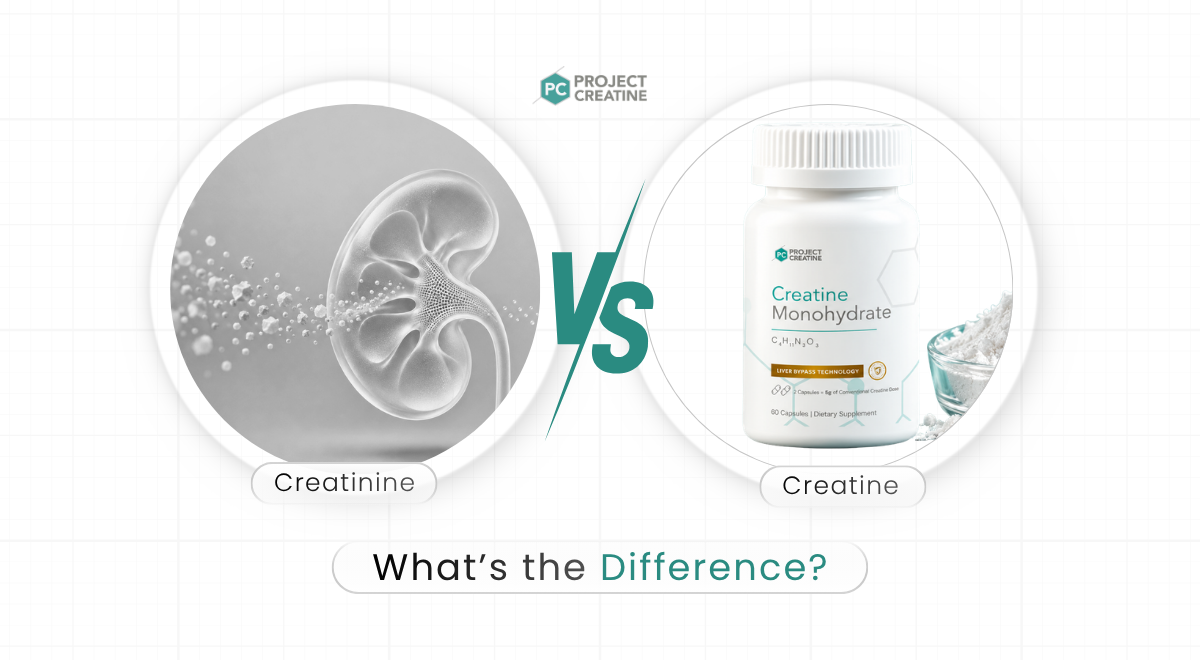
Creatinine and creatine have similar names, but different roles. Creatine helps your cells rapidly replenish energy, especially during demanding muscle activity. Creatinine is a waste product formed as creatine and phosphocreatine break down. Healthcare professionals measure blood creatinine to help assess kidney function.
Taking creatine can raise blood creatinine in some people without necessarily reducing kidney filtration. However, an elevated result should not automatically be dismissed as a supplement effect. This guide explains the difference, how to interpret the research, and what to discuss with your healthcare professional.
Quick answer: Creatine is a compound that helps support energy production, especially during short, intense activity. Creatinine is a waste product formed as creatine and phosphocreatine break down. The kidneys filter creatinine from the blood and remove it through urine. |
Creatine is a naturally occurring compound that your body makes from amino acids. You also get creatine from foods such as meat and fish. Most of your creatine stores sit in skeletal muscle, where creatine and phosphocreatine help support the regeneration of ATP, the main energy source used by cells.
If you are asking what is creatine, the simple answer is that it is part of the body’s short-term energy system. When muscles use ATP during demanding activity, phosphocreatine helps regenerate ATP so the muscles can keep working.
Your muscles store creatine as free creatine and phosphocreatine. During short, high-intensity efforts, phosphocreatine helps replenish ATP. This explains why researchers have studied creatine extensively in resistance training, sprinting and other activities that involve repeated high-intensity effort. Supplementation can increase muscle creatine stores beyond the amount most people obtain from food. The International Society of Sports Nutrition describes 3–5 g per day as a common maintenance range after muscle stores reach saturation.
Creatinine is a normal waste product that forms from the breakdown of creatine and phosphocreatine. Your muscles produce creatinine as part of normal metabolism, and your kidneys filter it from the blood before removing it through urine.
Doctors often measure serum creatinine as part of kidney-function testing. They may also use the result to calculate estimated glomerular filtration rate, or eGFR. A creatinine result does not tell the whole story by itself. Muscle mass, recent exercise, diet, hydration and creatine supplementation can all influence the number.
Doctors use creatinine because the kidneys normally remove it from the blood. A higher-than-expected blood creatinine level can occur when kidney filtration falls, but other factors can raise the number too. For example, the National Kidney Foundation lists high muscle mass, intense exercise, cooked meat and creatine supplements among factors that can affect serum creatinine.
This explains why a person who takes creatine may need to tell their healthcare professional before having kidney-function tests.
Creatine | Creatinine |
Naturally occurring compound | Waste product from creatine metabolism |
Helps support ATP regeneration | Removed from the blood by the kidneys |
Stored mainly in muscle | Measured in blood and urine |
Found in meat and fish | Produced naturally by the body |
Commonly used as a supplement | Not used as a performance supplement |
Supports the phosphocreatine energy system | Used as one marker when assessing kidney function |
Creatine and phosphocreatine naturally break down into creatinine. This process happens continuously, which means everyone produces creatinine even without taking supplements. Taking creatine can increase the amount of creatine available in the body. As a result, some people may see a modest rise in serum creatinine. That does not automatically mean the kidneys have stopped working properly.
Yes, creatine supplementation can raise creatinine levels in some people. A 2025 systematic review and meta-analysis found a small increase in serum creatinine after creatine supplementation but did not find a statistically significant difference in GFR between creatine and control groups. The authors suggested that the change may reflect creatine metabolism rather than impaired kidney filtration.
A 2026 systematic review of randomized controlled trials also found an increase in serum creatinine, while finding no significant difference in eGFR. The researchers said longer studies extending beyond one year would help add more long-term data. Another 2026 meta-analysis found that creatine increased serum creatinine and changed GFR when researchers calculated GFR from creatinine, but it did not find a significant change when researchers used Cr-EDTA, a different method of measuring filtration. The authors said the findings likely reflected changes in creatinine metabolism rather than kidney injury.
The message is simple: a change in serum creatinine does not automatically equal kidney damage. A healthcare professional should interpret the result alongside other information.
Creatine supplementation can affect serum creatinine, which is one reason healthcare professionals need to consider supplement use when interpreting kidney-function test results. A 2026 systematic review and meta-analysis published in the Journal of Renal Nutrition examined 19 randomized controlled trials and one double-blind randomized crossover study involving creatine supplementation and kidney-function measures. The researchers found that creatine supplementation was associated with an average increase of 0.13 mg/dL in serum creatinine. However, they found no significant differences in blood urea or estimated glomerular filtration rate (eGFR) between the creatine and control groups.
The authors explain that the increase in serum creatinine may reflect increased creatine metabolism rather than reduced kidney filtration. They also point out that serum creatinine has limitations because factors such as muscle mass, exercise, diet, and creatine intake can affect the result. For people who use creatine, this means a higher creatinine result should be interpreted in context rather than viewed on its own. The researchers suggest that healthcare professionals may consider other measures, such as cystatin C or inulin clearance, when a more specific assessment of kidney filtration is needed.
The authors also state that more long-term randomized trials are needed, particularly studies lasting longer than one year. Their findings therefore provide useful context for interpreting creatinine results but do not establish that creatine is appropriate for every individual.
Creatine has a large safety literature, but no supplement should be treated as suitable for every person.
A 2019 systematic review and meta-analysis found no evidence that creatine supplementation caused renal damage in the amounts and durations studied. A 2020 randomized clinical trial also measured serum creatinine, eGFR, proteinuria, albuminuria and kidney injury biomarkers after 35 days of creatine supplementation. The researchers found no significant difference between the creatine and placebo groups in the kidney measures they assessed.
More recent research adds some context rather than changing the basic picture. Studies continue to show that creatine can affect serum creatinine, while other kidney measures may remain unchanged. People with existing kidney conditions, abnormal kidney tests or medications that affect kidney function should discuss supplementation with a healthcare professional before starting it.
Creatinine and kidney stones are related to two different questions. Creatinine is a metabolic waste product that doctors measure when assessing kidney function. A kidney stone is a solid mineral deposit that forms when certain substances become concentrated enough in urine to crystallize. Current research has not established creatine supplementation as a cause of kidney stones in healthy adults. However, researchers have conducted far fewer studies on stone formation than on general kidney function. That means we should not claim that creatine prevents stones or has zero effect on stone risk.
One 2022 case report followed an athlete with a previous kidney stone. The athlete used creatine monohydrate for two months, and a follow-up ultrasound 14 months after stopping showed no recurrence. The authors could not associate the creatine use with a recurrence, but they also called for larger controlled studies. People with recurrent kidney stones should discuss creatine with a healthcare professional who knows their medical history. For more background, read our guide to creatine and kidney stones.
Tell your healthcare professional that you take creatine before having kidney-function tests, including the product and daily amount. Creatine can affect blood creatinine and the kidney-function estimate calculated from it. Your clinician can decide whether additional testing is needed. Do not assume an abnormal result is caused by your supplement alone.
The National Kidney Foundation also points out that creatinine alone cannot always provide a complete picture of kidney function because muscle mass, diet, exercise and other factors can affect the result.
If you decide to use creatine, start with the basics.
For conventional creatine monohydrate, research commonly uses 3–5 g per day for maintenance. Some protocols start with a creatine loading phase of about 20 g per day, divided into smaller servings, for 5–7 days before moving to a maintenance dose. Loading remains optional.
You do not need to take creatine at one exact time each day. Regular intake matters more than chasing a narrow timing window. If you want to know the best time to take creatine, choose a time that fits your daily routine. You can take it before training, after training or at another convenient time.
The words creatine and creatinine often appear together, which creates some of the confusion around creatine safety. Some of the common creatine myths we often hear are discussed here:
They are different compounds. Creatine supports cellular energy, while creatinine forms as creatine and phosphocreatine break down.
Not necessarily. Creatine supplements, muscle mass, exercise and diet can affect the result. An unexpected change should still be evaluated by a healthcare professional.
Current research has not established creatine supplementation as a cause of kidney stones in healthy adults, but direct research on stone risk remains limited.
Creatine supports cellular energy, while creatinine is a breakdown product used to help assess kidney function. Creatine supplementation can raise blood creatinine in some people, but that change alone does not establish kidney damage. Have unexpected results evaluated by a healthcare professional, especially if you have kidney disease or a history of kidney stones. You can also ask CreaTina, Project Creatine’s AI creatine assistant. CreaTina provides educational information based on published creatine research.
Educational disclaimer: This article provides general educational information and does not provide medical advice or diagnose, treat or prevent any disease.
[1] Akbari, H. A., Ghram, A., Knechtle, B., Weiss, K., & Saad, H. B. (2022, June 1). Effect of creatine supplementation on kidney stones recurrence inathlete: a case report. https://pmc.ncbi.nlm.nih.gov/articles/PMC9585689/
[2] De Oliveira Vilar Neto, J., Da Silva, C. A., Meneses, G. C., Pinto, D. V., Brito, L. C., Da Cruz Fonseca, S. G., De Sousa Alves, R., Martins, A. M. C., De Oliveira Assumpção, C., & De Francesco Daher, E. (2020). Novel renal biomarkers show that creatine supplementation is safe: a double-blind, placebo-controlled randomized clinical trial. Toxicology Research, 9(3), 263–270. https://doi.org/10.1093/toxres/tfaa028
[3] De Souza Almeida, A., Da Silva, L. O. D., Takahasi, B. N. A., Terada, B. D., Gonçalves, F. G. A., Porto, B. C., Da Silva Sardenberg, R. A., Passerotti, C. C., Maia, R. S., Samaan, F., Thoman, M., Molina, W. R., & Da Cruz, J. a. S. (2026). Impact of creatine supplementation on kidney health: a systematic review and meta-analysis. International Urology and Nephrology. https://doi.org/10.1007/s11255-026-05287-x
[4] Kreider, R. B., Kalman, D. S., Antonio, J., Ziegenfuss, T. N., Wildman, R., Collins, R., Candow, D. G., Kleiner, S. M., Almada, A. L., & Lopez, H. L. (2017). International Society of Sports Nutrition position stand: safety and efficacy of creatine supplementation in exercise, sport, and medicine. Journal of the International Society of Sports Nutrition, 14(1), 18. https://doi.org/10.1186/s12970-017-0173-z
[5] Naeini, E. K., Eskandari, M., Mortazavi, M., Gholaminejad, A., & Karevan, N. (2025). Effect of creatine supplementation on kidney function: a systematic review and meta-analysis. BMC Nephrology, 26(1), 622. https://doi.org/10.1186/s12882-025-04558-6
[6] Tsiaras, A., Loufopoulos, G., Theodoridis, X., Liakopoulos, V., Poulia, K. A., & Chourdakis, M. (2026). The Effect of creatine supplementation on kidney Function: A Systematic Review and Meta-Analysis of Randomized Controlled Trials. Journal of Renal Nutrition. https://doi.org/10.1053/j.jrn.2026.04.010
[7] Tsiaras A, et al. The Effect of Creatine Supplementation on Kidney Function: A Systematic Review and Meta-Analysis of Randomized Controlled Trials. Journal of Renal Nutrition. 2026. https://doi.org/10.1053/j.jrn.2026.04.010
No. Creatine supports the body’s energy system, while creatinine is a waste product formed during creatine and phosphocreatine metabolism.
It can. Research shows that creatine supplementation may cause a modest increase in serum creatinine. This change does not automatically indicate reduced kidney function.
Current evidence has not established creatine supplementation as a cause of kidney stones in healthy adults. Research specifically on kidney stones remains limited.
People with existing kidney disease, abnormal kidney tests or other kidney concerns should discuss creatine with a healthcare professional before using it.
Creatine monohydrate has the strongest research base. Other creatine types may have different properties, but a newer formulation does not automatically mean better results.
For most people, consistency matters more than taking creatine at a precise time. You can learn more about the best time to take creatine in our dedicated timing guide.
Yes. If you have questions about dosage, timing, hydration, creatine types or research, you can also ask CreaTina, Project Creatine’s AI creatine assistant. CreaTina provides educational information based on published creatine research.

Evidence-based creatine guidance